
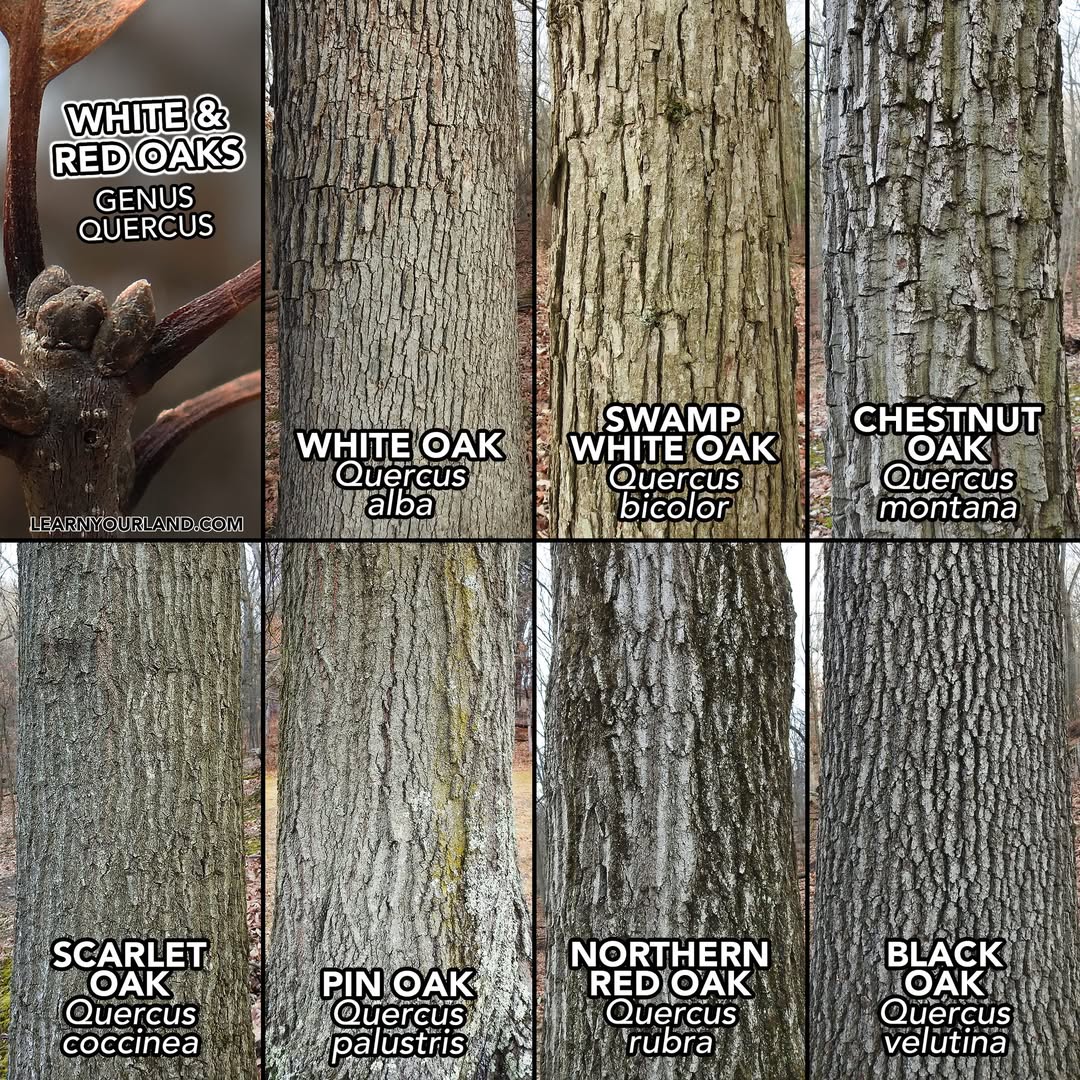
As the new year unfolds, why not embrace the challenge of learning a new skill? One that connects you to nature and deepens your appreciation for the outdoors. Identifying oak trees in winter might seem tricky without their signature leaves, but it’s a rewarding pursuit that will keep you engaged all year long. Let’s dive into the basics—and explore how different oaks influence the world of woodworking and furniture!
Red vs. White Oak Groups
In eastern North America, oaks can generally be divided into red oaks and white oaks. While bark patterns vary within these groups, some helpful distinctions exist:
• White Oaks (Top Row):
• White Oak and Swamp White Oak often feature bark that is platy and somewhat shaggy, giving them a weathered appearance.
• Chestnut Oak stands out with its ridged and deeply furrowed bark.
• Red Oaks (Bottom Row):
• Northern Red Oak is known for its consistent “ski track” patterns, which look like parallel vertical ridges running along the trunk.
• Black Oak typically has the darkest bark among red oaks.
• Scarlet Oak and Pin Oak share similarities but lack the prominent ski tracks of the Northern Red Oak.
How Oaks Differ in Furniture
White Oaks
• Furniture Uses: Known for their durability and water resistance, white oaks are commonly used in dining tables, chairs, flooring, cabinets, and whiskey barrels.
• Color and Style: White oak typically has a pale tan to light brown heartwood with a subtle olive undertone. Its tight grain and ray flecks give it a refined, classic look that works well in modern and rustic furniture.
• Ease of Work: White oak is relatively easy to work with, though its hardness requires sharp tools. Its closed grain structure makes it excellent for finishing, as it absorbs stains evenly and polishes to a smooth surface.
Red Oaks
• Furniture Uses: Red oaks are versatile and widely used for furniture, cabinetry, trim, and paneling. They’re also a favorite for contemporary designs due to their bold grain patterns.
• Color and Style: Red oak is lighter in tone, often with reddish or pinkish hues. Its grain is more pronounced and open, lending itself to a bold and dramatic look. It’s great for farmhouse-style or rustic furniture but can also shine in modern designs with the right finish.
• Ease of Work: Red oak is easier to machine than white oak but is more porous, making it less water-resistant. It absorbs stains well, but uneven absorption can occur, so preparation is key.
Notable Differences Between the Two
1. Grain and Porosity: White oak has a closed grain, making it naturally more water-resistant and ideal for outdoor use and liquid contact (think barrels). Red oak’s open grain is more porous and better suited for indoor applications.
2. Workability: Both are hard, but red oak tends to dull tools less. White oak, while tougher, delivers a smoother finish with fewer splinters when cut correctly.
3. Appearance: Red oak’s grain is more pronounced, while white oak offers a subtler, more refined aesthetic.
Tips for Identifying Oaks in Winter
If the bark alone isn’t enough to identify an oak, don’t worry—there are other clues!
1. Leaves: Look for leaves still clinging to branches or scattered near the base of the tree.
2. Acorns: Examine the acorns on the ground. White oaks produce sweeter acorns, while red oaks tend to be more bitter.
3. Location: Consider the environment where the tree is growing. Swamp White Oak thrives in wet conditions, while Red Oaks are often found in upland areas.
Practice Makes Perfect
At first, identifying oaks in winter might feel overwhelming. But with practice and patience, you’ll soon recognize the subtle differences between bark textures, acorns, and tree structures. And when you start to see these trees not just as part of the landscape but as potential furniture masterpieces, it’s even more rewarding!
As a modified Ben Franklin might have said, “An investment in knowledge [of trees] pays the best interest.” 🌟
Ready to Get Started?
Head outside, take a closer look at your local oaks, and see what you can uncover. Whether you’re identifying trees or crafting your next heirloom piece, the knowledge you gain will enrich your connection to nature and woodworking.
Tag us at @SnugHarborWoodworks and your inspiration @LearnYourLand to share your progress. Let’s make 2025 a year of growth—both for us and our appreciation of nature.
Happy learning, and happy new year! 🎉
Credit: Content inspiration from LearnYourLand.com and @LearnYourLand.
Leave a Reply